Make Counter-UAS Decisions
You Can Defend
UAVSimNet enables defence teams to simulate real-world intercept scenarios, quantify probability of success, and identify the most effective system configurations before committing to procurement or deployment.
Every result is traceable, reproducible, and backed by a structured evidence chain — ensuring decisions stand up under technical, operational, and procurement scrutiny.
Reduce risk. Eliminate assumption. Commit with confidence.
From assumption to evidence.
Counter-UAS decisions are routinely made using limited testing, vendor claims, and incomplete modelling.
This leads to misaligned procurement, underperforming systems, and operational risk that is only exposed after deployment.
UAVSimNet replaces assumption with evidence by making every parameter visible, traceable, and defensible — before a decision is made.
Four capabilities, end-to-end.
Simulate Real Intercept Scenarios
JSBSim-backed 6-DOF flight models allow realistic engagement modelling across target and interceptor profiles.
Understand What Drives Success
Every parameter is exposed, allowing identification of which factors materially influence probability of intercept.
Reproduce and Defend Results
Every run is deterministic and fully reproducible, with a complete audit trail of all inputs and assumptions.
Optimise System Design
Forward and inverse simulation identifies which configuration changes will improve performance, with quantified confidence.
Every parameter, sourced. Every result, frozen.
Every parameter in UAVSimNet carries:
- a defined value and unit
- a recorded source
- a confidence classification
- a supporting citation
All inputs are frozen into an immutable run snapshot, ensuring that:
- results cannot be altered retrospectively
- every outcome is fully auditable
- decisions can be justified under scrutiny

Find the right configuration on a workbench, not a range.
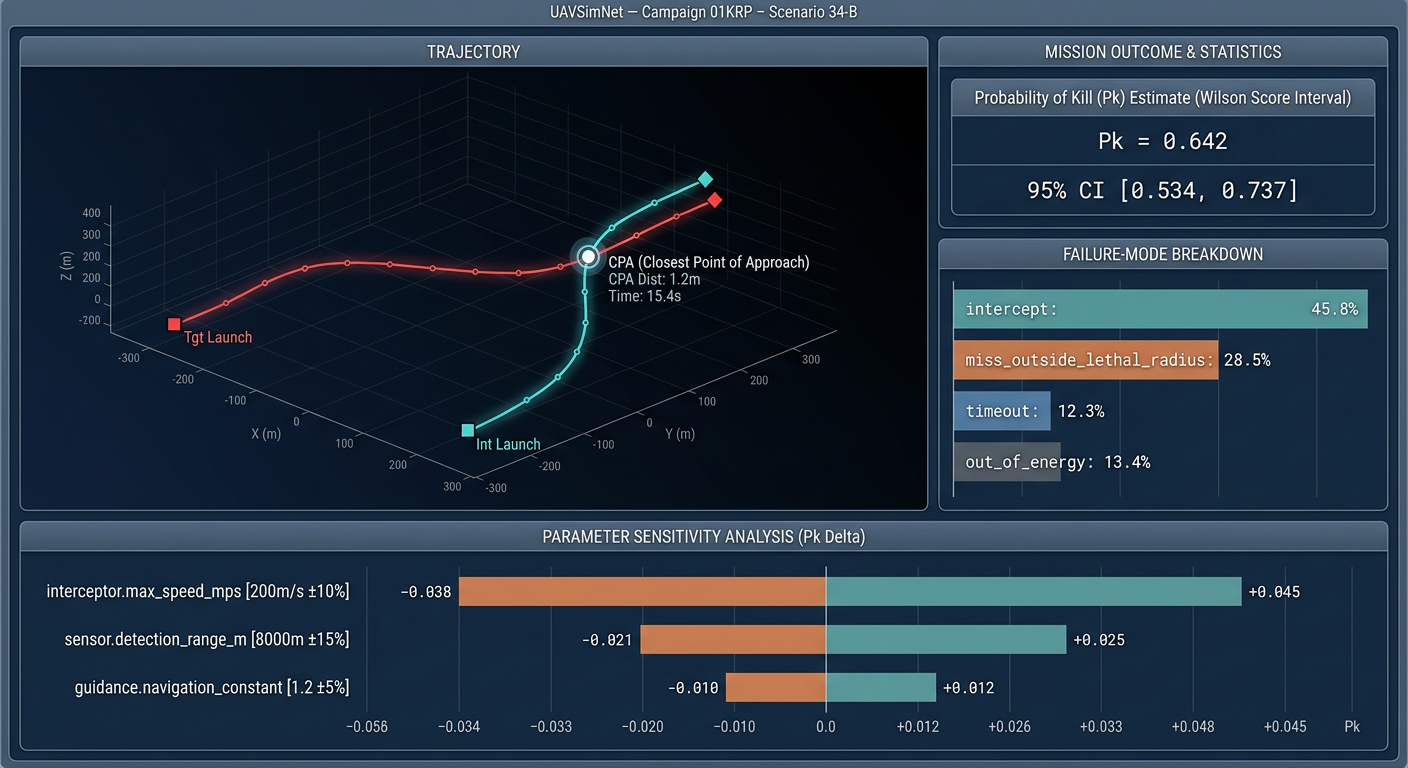
UAVSimNet evaluates proposed interceptor configurations, quantifies probability of success, and identifies which design changes are most likely to improve outcomes within defined constraints.
Outputs include:
Probability of kill with confidence intervals
Quantified Pk over Monte Carlo populations with bounded uncertainty.
Sensitivity to key parameters
Variance decomposition identifies which inputs move outcomes.
Recommended configuration changes
Configuration deltas that lift performance, with design-cost trade-offs.
This enables teams to converge on effective designs before physical development or testing.
Plan → Run → Analyse → Review → Promote.
UAVSimNet enforces a consistent workflow. Each stage carries forward the same evidence and provenance.
Built for the people whose decisions defend.
Defence procurement teams
Evaluating counter-UAS capability before commitment.
System integrators
Designing or refining interceptor systems.
Operational planners
Assessing real-world engagement scenarios.
R&D teams
Validating system performance before testing.
Evaluate Your System Before You Commit.
Submit a scenario or system configuration and receive a structured simulation-based assessment of performance, limitations, and optimisation opportunities.
Access is provisioned per engagement to ensure controlled, secure usage.